Ancestry archive · 1864–2026
The Kröker Line: a journey from Volhynia through Kazakhstan and Russia to Germany
An ancestry archive with genealogy, a migration map, EWZ documents and an open search for relatives.
First time here?
Where to start
Route
The Kröker journey
 before 1864Origin
Presumably West Prussian roots (based on the surname). No documentary confirmation yet — expected from Bundesarchiv R 9361-IV/18702.
 1864–1941Volhynia
Volhynian Germans. Village of Uvarovka / Neu-Aleksandrovka (Pulin district, Kyiv/Zhytomyr region). 1930–1935 — Pulin German National Rayon of the Ukrainian SSR, the only one in Ukraine.
 1941–1956Kazakhstan
Deported in 1941 from the village of Peski (Kharkiv region); villages of Semipolka (1941–1946) and Sennoye (1946–1956), North Kazakhstan. Emma released on 19.01.1956.
 1956–1987Dubovskoye
Emma Ivanovna lived with her sister Zinaida Simentsova in the village of Dubovskoye, Rostov region; both died there. Emma — 02.05.1987.
 1975–2023Shakhty
Son Vladimir Usachev (1950–2023) — driver of a GAZ-66 truck in a geological exploration expedition (surveying work), liquidator of the 1986 Chernobyl disaster (2nd group disability, medal). Wife Lyubov (née Kryshka) — Shakhty Cotton Mill (KhBK). Grandson Eugen born there in 1979.
 since 2019Berlin
A new chapter and continued archive research.
Swipe for more
Tree
A direct line of five generations
From the archive
Photos
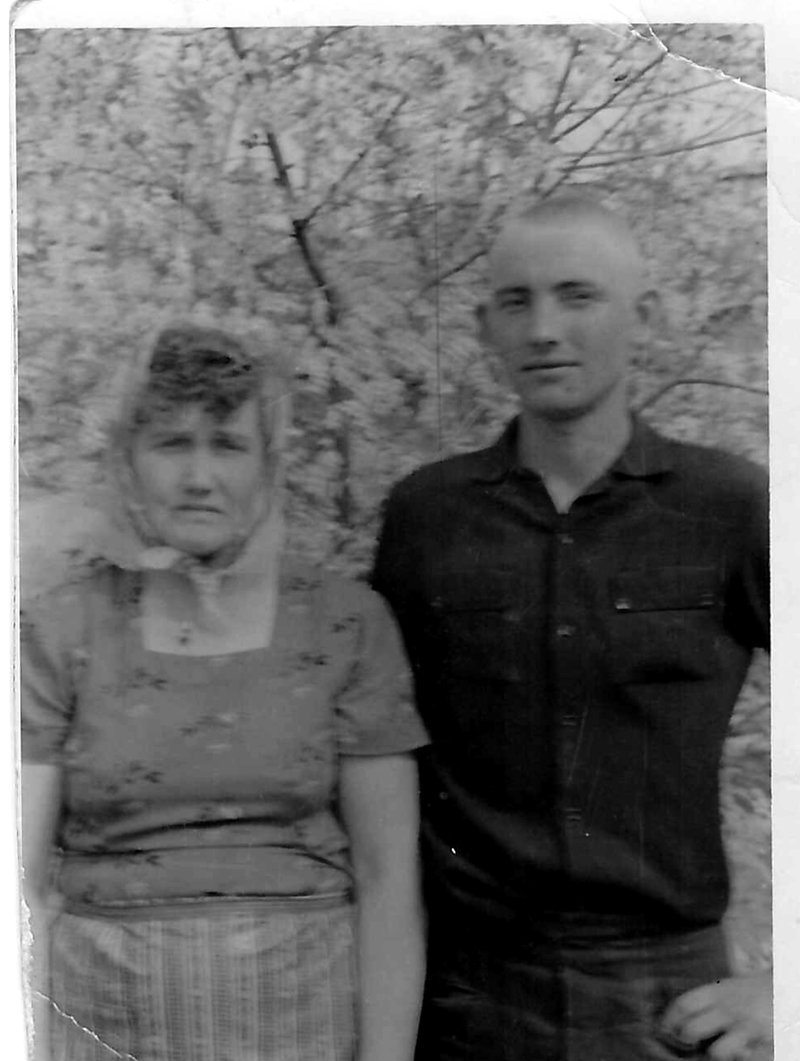
Main person
Emma Ivanovna Kröker (05.05.1924 — 02.05.1987)
Born in the German colony of Uvarovka / Neu-Aleksandrovka in Pulin district of Kyiv region (Zhytomyr region from 1937). In 1941, aged 17, she was deported from the village of Peski (Dvorichna district, Kharkiv region) to the North Kazakhstan region as a person of German nationality. 15 years in special settlement: village of Semipolka (1941–1946) → village of Sennoye, Sovetsky district (1946–1956). Released on 19 January 1956.
Read more
After release she moved to the village of Dubovskoye (Dubovsky district, Rostov region), where she settled together with her elder sister Zinaida Ivanovna Simentsova (b. 1920, also released from special settlement). Both sisters lived in Dubovskoye until the end of their lives and are buried there.
Emma Ivanovna died on 2 May 1987 in the village of Dubovskoye at the age of 62. Posthumously rehabilitated in 1993 under Russian Federation Law No. 1761-I. Personal file No. 1229 (28 sheets) is kept at the Branch State Archive of the Ministry of Internal Affairs of Ukraine (HDA MVS Ukrayiny), fond 161, inventory 1, file 877; digital copy obtained on 14 May 2026.
Father's line
Vladimir Nikolaevich Usachev (08.04.1950, Sennoye — 06.08.2023, Shakhty)
Son of Emma Ivanovna Kröker. Born in special settlement in the village of Sennoye, North Kazakhstan region. In the original birth record entry the father is given as "Vasiliy" (identity not established); later the entry was rewritten to name his stepfather Nikolai Maksimovich Usachev (his mother's marriage on 26.07.1952).
Read more
He spent his first six years with his mother in Sennoye; in 1956, after Emma Ivanovna's release from special settlement, he moved with her to the village of Dubovskoye (Rostov region). He completed the Kupiansk Tractor Vocational School in the town of Kupiansk, Kharkiv region of the Ukrainian SSR — in the very region from which his mother had been deported in 1941 and to which she was forbidden to return for life.
Until 1975 he worked as a driver of the long-distance "Ikarus" bus on the Rostov — Kharkov route. Around 1975 he moved with his wife Lyubov (née Kryshka) to the city of Shakhty (Rostov region) and became a driver of a GAZ-66 truck in a geological exploration expedition (surveying work). Lyubov worked at the Shakhty Cotton Mill (KhBK). In 1979, their son Eugen was born in Shakhty — the author of this ancestry archive.
In 1986 Vladimir Nikolaevich took part in the liquidation of the consequences of the Chernobyl nuclear disaster. 2nd group disability. Certificate of a Chernobyl liquidator, and the medal "For Participation in the Liquidation of the Consequences of the Chernobyl Disaster".
Vladimir Nikolaevich Usachev died in Shakhty on 6 August 2023.
Open questions
Unresolved research questions
Who was “Vasiliy” — Vladimir's biological father?
In birth record No. 13 of 14.04.1950 the father is listed, per the mother, as “Vasiliy”; his identity has not been established. The hypothesis about Vasiliy Frantsevich Kreker (~1912, Crimea) is unconfirmed. The registry-office trail is exhausted — the search continues through DNA (GEDmatch).
Where did the Krökers come to Volhynia from?
West Prussian roots are presumed from the surname (first recorded in Tiegenhagen, 1627). Confirmation is expected from Bundesarchiv EWZ file R 9361-IV/18702.
The fate of Johann Kröker after 1924
The exact date and place of the great-grandfather's death are not established (ca. 1924, Volhynia). Searching Volhynian parish records.
Where are the descendants of Leo Dreger and Sinaida Simentsova?
Leo (*1937) lived with his mother in Sennoye from 1945; Sinaida in Dubovskoye, Rostov region. If you know their descendants, please write via the contact page.
Contact
Contact the author
Support the project
Support the archive research
The Kröker ancestry archive is a private, non-commercial project. If it has helped you find relatives or documents, you can support continued work.
Where donations go
- Archive certificates: EWZ Bundesarchiv, Kazakhstan Prosecutor's Office, Kharkiv State Archive, Petropavlovsk Civil Registry
- Trips to archives: Berlin Bundesarchiv, Kyiv, Petropavlovsk
- DNA tests and GEDmatch publications to find biological relatives
- Scanning and digitizing archive photos and documents
- Translations from German, Russian and Ukrainian
- Digital tools, document processing and website maintenance
Current goal: obtaining the complete EWZ file R 9361-IV/18702 from the Bundesarchiv and digitally processing the archive materials. Every contribution brings the next discovery closer.
All funds go only to research. I don't earn anything from this site. Support via PayPal, Ko-fi and ЮMoney is a voluntary private contribution, not a tax-deductible donation — this project holds no official non-profit status.